

.jpg)
Ikhlss Tamlih*
The Palestinian banking sector serves as the primary artery of financing for Palestinian economic development, and the essential guarantor for providing comprehensive financial services required by various economic activities and social segments. It is heavily relied upon in development plans as the main source of funding for both the private and public sectors.
The aim of this article is to shed light on the role of the Palestinian banking sector in enhancing and increasing the economic growth rate, as well as achieving the objectives of sustainable development. This will be accomplished by analyzing various banking and financial indicators of the sector, examining their impact on macroeconomic indicators, and assessing the changes in banking responsibility for the Palestinian community and targeted sectors.
Sustainable Overall Growth
Sustainable development is a dynamic process that requires stimulating national will and mobilizing the necessary human and material resources to bring about the desired change in economic growth, raising living standards, and well-being for society. Consequently, the policies of the Palestinian Monetary Authority over the past two years aimed to inject more liquidity into the local economy, either by providing the necessary financing to bridge the Palestinian government's budget deficit or by directing the banking sector to expand credit grants for productive projects and infrastructure initiatives. Additionally, facilitating the establishment and entry into partnerships with investors in renewable energy and digital transformation sectors contributes to revitalizing the local economy and fostering economic development.
Statistics indicate a growing utilization of bank funds in the Palestinian local economy and a gradual reduction in external investments. The proportion of local investments reached 79.3% in 2022[1], while in 1996, it accounted for only 31.2% of total deposits. This progress marks a notable and continuous success in re-channeling deposit funds to serve the local economy, distributed among loans, investments, deposits, and fixed assets. Approximately 20.7% were invested abroad, and this increase in the use of funds within the local economy channels stimulates economic growth.
Credit policies play a pivotal role in stimulating the overall economy and alleviating some undesirable economic and social phenomena, such as unemployment and poverty. The credit facilities portfolio accounts for the lion's share of total banking assets, reaching approximately 51.5% by the end of 2022, an increase of about 3% from 2021, amounting to nearly $10.6 billion. Palestinian banks have shifted to granting more credit to Jerusalem and the Gaza Strip, as well as stimulating the small and medium-sized enterprises sector and high-productivity sectors. They have also focused on sustainable economic activities such as technology, education, entrepreneurship, and tourism. This shift highlights the banks' commitment to further employing their financial resources in the local economy despite the risks and challenges.
The following figure illustrates the strength of the linear relationship between the Gross Domestic Product (GDP) and the value of direct credit facilities granted by banks operating in Palestine. This indicates the depth of impact and the connection between bank credit and the productivity of the national economy. Additionally, an increasing trend can be observed for both variables over time during the period (2008-2021), which confirms the influence of the banking sector on the real economy. This is achieved by increasing the volume of liquidity in the economy's channels, subsequently enhancing economic growth and improving overall financial stability.
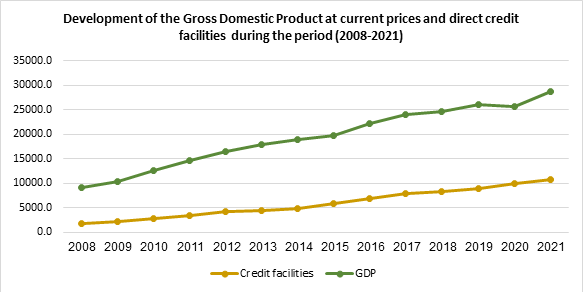
Source: Palestinian Monetary Authority, Publications, Annual Data, Key Economic Indicators.
The need for responsible financing during crises becomes evident to ensure a balance between effective, coherent financial policy planning and the flexibility to adapt to crises, as well as coordination among various sectors to overcome complex circumstances. During the COVID-19 pandemic, the banking sector set an exemplary model for the private sector, with the community banks' contributions to the affected economic sectors increasing by 93.3% from 2019, reaching more than $8.4 million. The Palestinian Monetary Authority launched the "Sustainability" fund, dedicated to providing financing for small and medium-sized enterprises (SMEs) and micro-enterprises economically affected by the pandemic, particularly those managed by women, with a total value of $425 million. This financing enabled these businesses to cover emergency operational expenses, support working capital, and continue paying employees' wages, allowing them to maintain production and provide services. Consequently, this helped contain the anticipated financial crisis and enabled business owners to overcome the challenges.
A Financing Plan Ensuring No Public Sector Crowding Out of the Private Sector
One important aspect of understanding the real role of credit in economic activity is to shed light on the volume of facilities granted to both the public and private sectors, and whether the government is crowding out the private sector in obtaining financial resources. The ratio of credit facilities directed to the private sector as a percentage of GDP increased from 20.7% in 2008 to 45.9% in 2021, accounting for 79% of total facilities by the end of 2022.
As illustrated in the following figure, the volume of credit directed to the private sector has been increasing over time, especially in recent years. The increase in credit directed to the private sector is accompanied by a relative increase in credit directed to the public sector as well, due to the financial crisis faced by the government as a result of fluctuations and decline in the volume of international aid provided to the Palestinian Authority, and the Israeli occupation's seizure of clearance revenues.
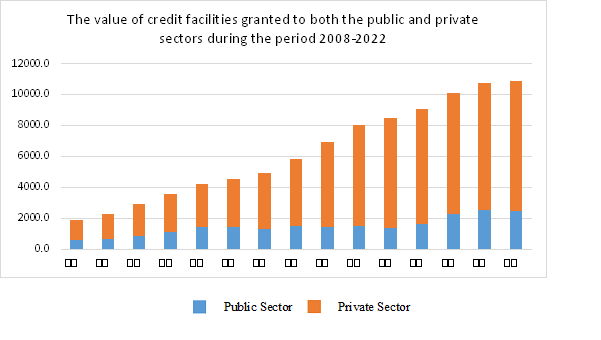
Source: Aggregated data from the Association of Banks Operating in Palestine and the Palestinian Monetary Authority, Publications, Annual Data, Key Economic Indicators.
A key indicator confirming the absence of crowding-out is the increasing ratio of credit granted to the private sector as a percentage of private sector deposits over time. Consequently, the facilities granted to the public sector are mostly at the expense of reducing banks' external balances, rather than reducing credit directed to the private sector. Banking policies in Palestine work towards re-injecting private sector savings to finance local economic activity, thereby significantly improving the efficiency and performance of banks as financial intermediaries, depending on mobilizing savings from surplus units and redirecting them to deficit units within the economy.
Sustainable Community Development
Corporate social responsibility (CSR) is a fundamental aspect of quality management for banks operating in Palestine, serving as a complementary part of their overall strategy and sound governance. According to the World Bank, CSR is defined as "the commitment of business owners to contribute to the achievement of sustainable development goals by working with their employees, families, local communities, and society as a whole to improve people's living standards in a manner that serves both business and development simultaneously."[2] Based on this definition, the primary objective of private sector CSR is to achieve sustainable development. The Sustainable Development Goals (SDGs) are a set of 17 objectives established by the United Nations and adopted at the United Nations General Assembly meeting in September 2015. These broad goals are interconnected and cover a wide range of social and economic development issues.
Since November 2010, the Palestinian banking sector has demonstrated early awareness and a genuine sense of its social responsibilities by initiating the "First Social Responsibility Forum." This event, organized by the Palestinian Monetary Authority and the Association of Banks in Palestine, laid the foundation for unifying the philosophy of social responsibility within an integrated developmental framework for the banking sector. The forum aimed to create a policy framework for CSR that promotes partnership between the private, public, and civil sectors. Among the forum's demands was a requirement for banks to allocate 2% of their profits for social responsibility[3] and to explore the establishment of a joint fund for sustainable CSR activities.
CSR programs targeted by banks operating in Palestine are aligned with the extremely difficult living conditions experienced by Palestinians. According to the latest 2017 indicators from the Palestinian Central Bureau of Statistics, the poverty rate, based on monthly consumption patterns[4], reached 29.2% in the Palestinian territories. Meanwhile, 41.1% of Palestinians have a monthly income below the national poverty line.
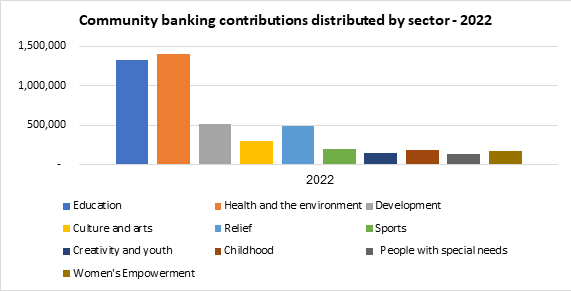
The following figure shows the sectoral distribution of social responsibility contributions made by banks operating in Palestine. In 2022, the total community banking contribution reached $4.9 million, a 2.3% increase compared to 2021. Contributions in 2022 were primarily focused on the health sector (28.7%), followed by the education sector (27.1%), development (10.7%), relief (10%), culture (6.2%), sports (4%), childhood (3.8%), women's empowerment (3.4%), youth and innovation (3%), and individuals with special needs (2.8%).
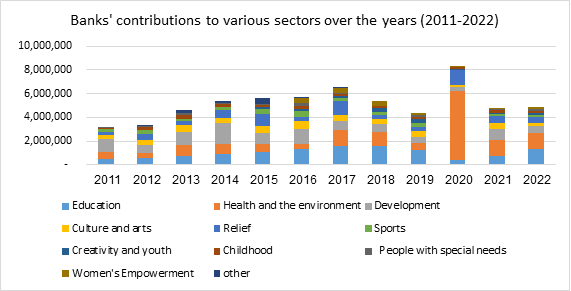
In 2020, the contributions of the banking sector rose by 93.3% compared to 2019, as shown in the subsequent figure, amounting to $8.4 million, an increase of $4 million more than in 2019, through 372 partner institutions. This increase coincided with the outbreak of the COVID-19 pandemic and the precautionary measures that led to the paralysis of trade and industry, as well as the occupation's withholding of clearance revenues for more than seven consecutive months, resulting in a sharp decline of 11.5% in Palestine's GDP.
To bolster the health sector's preparedness in combating COVID-19, contributions to the health sector increased by $5.3 million compared to 2019, more than tenfold, despite the banking sector's adverse effects from the pandemic. Support was provided to the Ministry of Health through devices and equipment necessary for detecting the coronavirus, ventilators, and awareness campaigns on the importance of preventing infection across all societal groups, including workers, the elderly, mothers, children, and individuals with special needs who are more susceptible to infection. Campaigns were focused on lower-income areas. The banking sector continued its support for regular health projects, including equipping Jerusalem hospitals and raising awareness about diabetes prevention and the importance of early detection of breast cancer.
In 2020, the banking sector also tripled its contributions to relief efforts compared to 2019, working to combat poverty and support humanitarian efforts to assist those who lost their jobs during the COVID-19 pandemic. Aid was provided to impoverished families and those in need registered with the Ministry of Social Development in all governorates of the country, supporting the social safety net and protection for those affected by the pandemic.
The contributions of the banking sector were not limited to the health and relief sectors but also encompassed other crucial areas such as banks' commitment to supporting the environmental aspect within the framework of green banking initiatives in Palestine. Numerous natural parks have been opened, increasing green and clean spaces. Palestinian banks have also been at the forefront of the country's nascent green economy, showing keen interest in supporting renewable energy projects in line with their commitment to achieving sustainable development goals.
On the other hand, banks have launched projects to empower women and support efforts to reduce inequality and exclusion experienced by women in marginalized areas. This has been accomplished through supporting productive projects, backing rural product market bazaars, and training women in life skills for labor market integration within various programs. Banks have also directed their efforts to support numerous projects empowering individuals with intellectual and physical disabilities and promoting Palestinian culture and cultural heritage.
In conclusion, as mentioned at the beginning of the article, the challenging humanitarian conditions we face today highlight the urgent need to direct our financial resources towards initiatives that benefit the Palestinian people in preserving their lives, health, education, and employment. It can be said that the Palestinian banking sector has played a decisive role in building a stable and prosperous Palestinian economy and achieving sustainable development goals.
* Economic researcher
[1] Data source: Association of Banks in Palestine, unpublished data.
[2] Al-Asraj, Hussein (2012), Activating the role of corporate social responsibility in economic and social development in Arab countries. National Planning Institute, Egypt.
[3] There is currently no legal obligation for banks or joint-stock companies to allocate a percentage of profits for social responsibility. However, the voluntary contributions of banks operating in Palestine have reached more than 6% of total profits for community responsibility projects in various sectors.
[4] This indicator is based on the cash consumption level of the standard household, but it does not include other types of deprivation such as: the right to access health services, the right to obtain appropriate health services, the right to decent work, access to suitable education services for all family members, the presence of chronic diseases, the presence of disabilities, and other rights that are overlooked by the concept of monetary poverty and are revealed by the concept of multidimensional poverty.